Saturday, June 9, 2007

Flannery O`Connor-Little Miss Southern Discomfort

I got this here book at Book People after I read a story in the New York Times. It was in the travel section, where I can go anywhere in the world for free, and appeared on February 4th, the day after my birthday, and was titled "In Search of Flannery O`Connor" by Lawrence Downes. He took a trip to Andalusia, which is the farmhouse where Flannery grew up; that`s Milledgeville, between Atlanta and Savannah, Georgia, a fairyland for we Texans. Yea, rather deep in the heart of Dixie! There were photos of the dary farmhouse and a snap of her old typewriter; one could deflect a thimble of inspiration from seeing her bedroom where she wrote religiously for three hours everyday. I was drawn to her because I was curious what is meant by "the Southern writer"? What does that really mean? I picked up "The Sound And The Fury" by William Faulkner a couple of weeks ago, and I am about half way through it. This Norton Critical Edition has some essays that discuss the "Southern Thing", but this novel was published in 1929, just as The Depression was beginning. Flannery O`Connor`s stories were published more from the mid-fifties to the early sixties. She died from Lupus in 1964, and thus she must have experienced the beginnings of the Civil Rights Movement. She deals with the issue of race, but mainly through the bigotted veneer of her raspy, rascally heroes and villains.

I`ve only read maybe five short stories so far, but am just blown away; the impression I get is like Bonny and Clyde, bullets and romance, the lonely, or the lost and forgotten ("The Grapes of Wrath" is recalled) . I think I will go back to Book People today and see if I can grab "The Violent Bear It Away" or "Wise Blood", her only two novels. I heard that many of her letters may soon be published too, and this will reveal more about her peculiar demeanor, her take on the South, and the tense religious chasm that bubbled under her feet like Dante`s Inferno. This is a general page from which you can read more `bout the belle Flannery and her peacocks, cornpone or jangling trolleys! I just read "The Artificial Nigger" last night and really came away with unusual feelings in my gut. I had grown up in Houston in the early sixties and was use to the two-tiered society and the symbolic division between the have and have nots, between the suburbs and alternative society across the railroad tracks. What I take away is that when Mr Head and Nelson see the little black yard effigy in an upper-crust anglo neighborhood, they were relieved that those people had been put back in their place(they saw the effigy as this type of symbol). When they visited a real black town of Atlanta, and talked to the sultry, sassy mamma, they were frightened out of their wits! Oddly, the epiphany experienced by Mr. Head is more the conviction that the social stratas remain firmly in place. This is a twisted irony as such, and his struggle with God for his sins of denial, when Nelson was in need of service, do not retain a strain of sincerity. Rather, his bigoted world remains in tact! Indeed, very unusual-but maybe that`s the way it really went down with many of these rapscallions. Also, the language is a literary gold mine, and many of the lines require innumerable re-readings, where the meanings shift as shades of light on a Monet haystack. The treetops, fencing the junction like the protecting walls of a garden, were darker than the sky which was hung with gigantic white clouds illuminated like lanterns.

I really wonder how Flannery could of thought up all these stories, unless she just had an incredible,...a vivid or even wild imagination. She most certainly did have one. I read that Sherman`s March went right through that area of Georgia. I had just seen a good special on Sherman on The History Channel about a month ago, and I knew that the resentments felt by Southerners were yet still smoldering, if not flaming. I`m inclined to believe that some of that is baked into Flannery`s cake mix, her literary daffodils. When I was reading "A Good Man Is Hard To Find" I kept thinking of Key Largo and Humphrey Bogart as the crook holding those good people captive. Yea, he seemed like the Misfit, very ornery and up to no good-hey, down right pure evil! When I was young, in the early sixties, we drove through the deep south, and I saw cotton fields, wooden shacks with poor children playing, run-down gas stations with rinky dink coca-cola machines, home-cookin` diners, town folk scurrying to the bus stop....some of this must have been part of Flannery`s world? "The River" has a bad ending and "The Life You Save May Be Your Own" is about a flim-flam man, a confidence artist who takes an old woman and her over-ripe daughter for a ride, but you still sympathize with him when he abandons the daughter...uncooth but whew, he got away! I kept thinkin` of Jack Nicholson in "Five Easy Pieces" bailin` and leavin` Karen Black at the truck stop. I just found out that Wise Blood had been made into a movie (1979) with Brad Dourif, Ned Beatty, and Harry Dean Stanton-gonna snatch it up quicker than a flapjack on a Kettle griddle! I`m gonna read more of her works and skirt some of the issues about her Southern-ness. An undulating (developing) theory I have, is that the closer the writer is to the Civil War, or maybe to the Antebellum Period, the more unique they are...the more Southern by nature. Thus, since Faulkner wrote much in the twenties, he is more Southern than Flannery O`Connor! No doubt, this theory may have to jump many treacherous, fiery hoops... but hopefully the circus tent won`t burn down?? Last night a funny moniker came to mind, and it has been stickin` so far-Little Miss Southern Discomfort! She is a fireball, an enigma where Catholicism and Protestantism are wrestling furiously, with her surprise endings and characters who long for redemption but are tethered by their own gremlins!

Saturday, June 2, 2007

Julius Caesar-"Et Tu HBO."

I was right glad to get the first two episodes of HBO`s series "Rome" in the mail yesterday from my good friends at Netflix. I`ve already seen a lionshare of episodes for Season Two, save one or two. "The Stolen Eagle" is the very first part, and clips in ingeniously to the point of the end of Caesar`s Gallic Campaign, during the time when he was significantly close to returning to Rome, after battling the barbarians (the Gauls) brutishly (pardon the pun) for eight or nine years. The scene of the triumphant parade of his returning legions to the Roman Forum was bedazzling, especially in terms of the sets built for the production (okay, maybe this was before Caesar returned, and was just a political rally or party in the street? I just focused on the sets of the Forum. This is also an argument for owning the whole box set; i.e. when mortal memory flies the way of Hades!). After visiting Rome myself in 2000, and having walked around the ruins of stone-stumps, monument fragments, & busted busts of nocturnal nobles, I`ve often had difficulty imagining what it truly looked like more than 2000 years ago. Caesar had done much to rebuild the Roman Forum too, so it was sterling in appearance in say 50 BC, and not terribly cluttered yet, mind you. My favorite scene of this episode one however, was the bull-sacrifice performed on Atia of Julii. She was the frothy, libidinous mother of Octavian, and wanted to ward off any evil that might be done to her son, who was in Gaul on some business of the State. The bull is slain and his blood pours over Atia, played marvelously by Polly Walker, in an apparent purification sacrifice. I suspect this was a part of the Mother Cybele cult that came from the East, maybe from Phrygia. Bull-sacrifice was also practiced in the religion of Mithraism, a topic I have explored properly some years ago (at that time it was a fresh area of study). It is a good idea for one to eliminate this as the actual reference in this first episode though, since Mithraism did not spread throughout Rome until later in the Empire (100-200 AD). Its popularity was largely due to the daily needs of religion for the common Roman soldier. There is always the possibility that the HBO writers just threw this in for dramatic effect, but it is conceivable that there is evidence for such Bull-Sacrifice-Rituals (more likely in a Mother Cybele context) in Caesar`s era!

I am very fascinated by the life and career of Julius Caesar, and have been reading "Caesar-Life of A Colossus" by Adian Goldsworthy. I had read Mr. Goldsworthy`s treatise on the Punic Wars, and knew him to be a reliable scholar on these matters of antiquity, and most assuredly for the military campaigns. The victories from the Punic Wars essentially clinched Rome as the dominant power in the Mediterranean world, and isolated Carthage as a minor player in the Mediterranean, after Hannibal nearly conquered Italy with his lumbering elephants and exotic mercenaries. When the HBO series begins, we see the harbingers for the Civil War between Caesar and Pompey the Great just emerging. I searched for a reliable reference to the stealing of the Golden Eagle by Pompey`s affiliates, but to no avail. It must have been fabricated by the HBO writers, but a very clever device in the plot was interjected nonetheless. Too, I enjoyed seeing the adversarial relations between Caesar and the senate emerging; Cato is always an arch-enemy of Caesar but Cicero plays both sides of the fence, and is a relentless champion of the Republic. Early on Caesar and Pompey are chums, but later on after Julia dies, daughter of Caesar and wife of Pompey, relations sour. I suspect that much of the first season centers on the Civil Wars, documenting the unravelling of the First Triumvirate, so I`m really looking forward to viewing it (this is the fulcrum of Roman History, I`ve come to believe). Moreover, and as a tangible footnote, I have always been a fan of the BBC series "I Claudius", but remember Bovee (duhh), that was in the late 1970s! Maybe some of the young people of today would enjoy inspecting its contents and reaching conclusions after comparing it to "Rome". Robert Graves (the author of "I Claudius") also has the best translation published for "The Twelve Caesars" by Suetonius, a volume that has been a friend by my side for thirty years or more. All of this enthusiasm has come about because I intend to create quite a few posts about Caesar. There are two films of the Shakesperean play that I will write reviews on, and the one with Jason Robards (he delivers his lines in a sluggish, Dashell Hammettesque prescription, such that Bill Shakespeare would turn & maybe even quiver in his grave with ample angst-I`m wondering if I can even bear to watch this again) as Brutus from the late 1970s is a hoot! The Man From Uncle, Robert Vaughn, is in it too. But seriously, Caesar is a study of power, maybe the classic study of power or ambition; how to get it, how to use it, then eventually how you lose it! "Veni, Viti, Vici!" or Et Tu HBO for having the thoughtfulness to present this compelling story of an important figure, if not the most important one, of antiquity!

Saturday, May 26, 2007

Let Them Eat Cake!


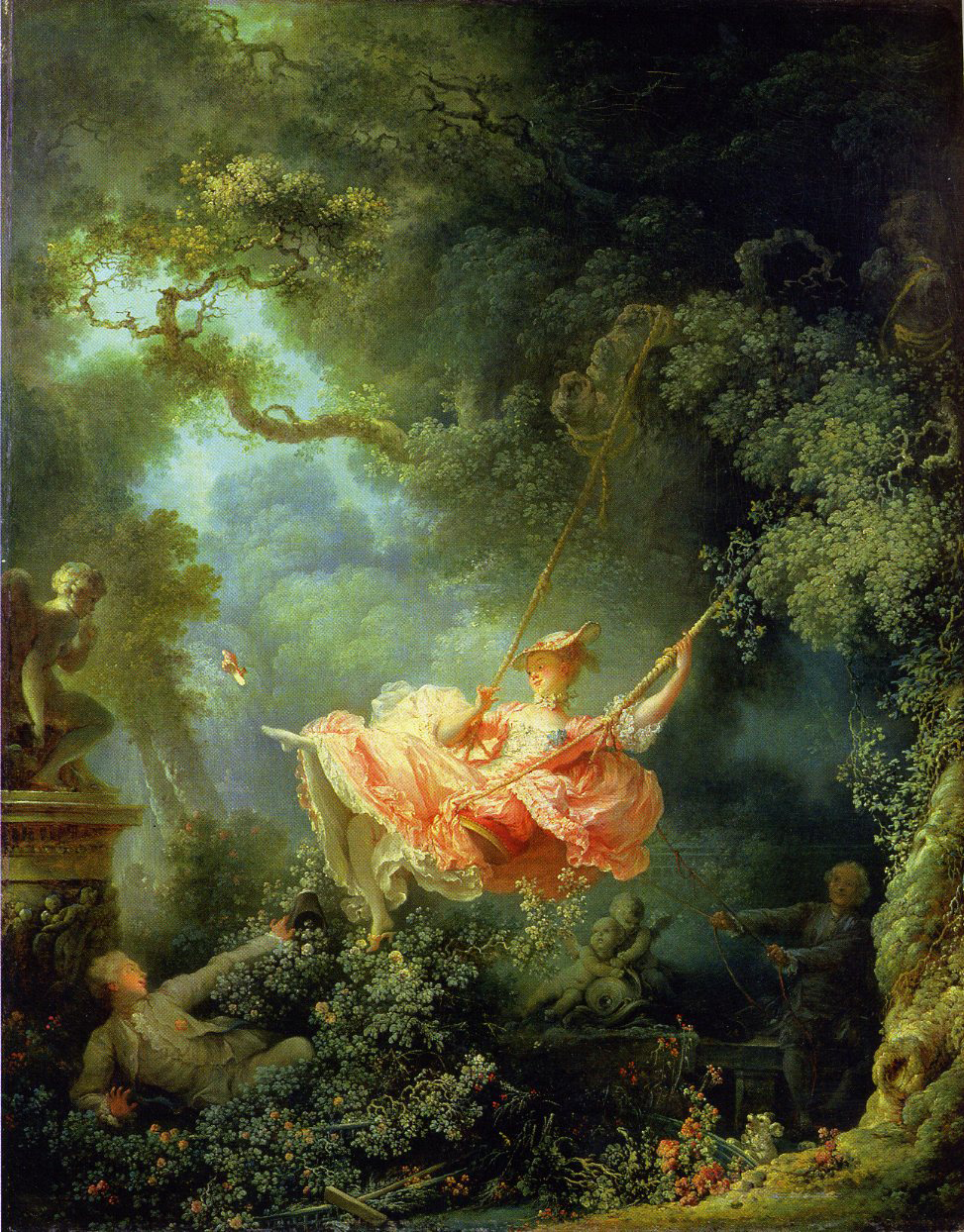
After watching Sophia Copola`s Marie Antoinette, I was curious about the real French Queen, and picked up the biography Marie Antoinette by Antonia Fraser. The movie is a bit fanciful, but is a mere pop version of this important historical personage (apparently the book was Sophia`s primary reference). I did enjoy it, but being a devotee of history, I longed for the actual dame of the Austrian court. I am only on page 51, but I detect that it is well researched, and am enjoying it immensely. "Let Them Eat Cake!" This is a phrase that echoes throughout infamy (prep schools, union halls, or menacing water holes mostly). There is not a shred of evidence that Marie ever said it, if you listen to scholars, but it has come to symbolize the contempt that the aristocracy of France had for the people of the lower estates. Just how over-the-top was the French court in the years leading up to the French Revolution? Was the atmosphere of the latter days of the ancien regime at Versailles as luxurious as it is depicted in books and films? I am hoping this book will perform surgery on some of the thick skins of exaggeration that have here-to-fore been the preponderance of portrayals for the Sun King court. A few years ago I got hooked on Francois Boucher simply because he was so frothy, so decadent-almost more so than one could believe? I visited a Kimball exhibition a couple of years back, and was befuddled by all the angels, cherubim, seraphim etc...How did the art develop such as this, to this silky silliness, with mountains of pinkish flesh in a transparent (or fake) religious theme? This astounded me, and made me want to study the period more to decode these aberrations. Too, the example of Fragonard`s The Swing is given, to slam home the point that mid-18th century France was a plump goose ready to implode with social/political mutiny! This was convincing, when I scribbled down these developments in my history notebooks. "Yea, there it is, the flagrant opulence of the ancien regime, no mercy dude!"


The above portrait by Louise Elizabeth Vigee-Lebrun, while very staged, gives you a good idea of what Marie was like; sumptuous, haughty, majestic, stoic, or maybe just downright in fruitcake city? Was this the real Marie, or just a facade for the public? I will probe for that as I read the book. Louise Vigee-Lebrun did many other portraits of the Queen, so they provide visual fodder for the mozaic of a gazillion words in Antonia Fraser`s text. There is a documentary on Madame Antoine too; I ordered it on Netflix, but it malfunctioned when I was playing it, so I intend to actually purchase it, because it is well done. Maybe some day I can go to France, so that I can visit the haunts of the aforementioned lady, then I will really sense the way it went down! "Let Them Eat Cake", in the meantime (you may want to view this slideshow as you contemplate this fallacious trigger for the Fall of the Bastille)!

Sunday, May 20, 2007

Fay Grim, Waitress, & 28 weeks Later

The Dobie Theater was a little too hot yesterday, but it got colder as the movie progressed. Fay Grim really got bogged down in silly, spy-chit chat that didn`t make any more sense than a fly that was flittin` `bout my nose! Read Roger Ebert`s piece, and boy am I glad he`s back. Parker Posey grimaces, snarls, winks, etc...and is reckless fashion-plate for this lunkey flick. But she can`t save it...this is Ian Fleming gone south. I know I need to see Henry Fool, but I`m reluctant to do so after this clunker! Loved the high-definition though and good shots of Istanbul.

Waitress was a very cute little film that recalls an easier, more innocent age, which would not be our own however. There was something untrue about it, and i don`t know just why? The pie-recipes in it were interesting. Andy Griffith is good as the bitter, wealthy owner. Keri Russel is good and Adrienne Shelly plays a dumb, nerdy flap-jacker strutter who hitches to a bad-poetry dork. It is tragic about her murder late last year.

My favorite of these three was 28 Weeks Later, especially because of the birds-eye shots of London, and the senseless slaugher by the government to annilhilate the carriers of the Rage virus. Because of the virus, people lose feeling for one another. Whenever a carrier tries to eat someone, they move real fast and snatch up their lunch before you can whistle dixie! Dark comedy really-modern George Romero. There is a real rockin` soundtrack-kind of sounded like King Crimson, but I`ll have to check it out! Just about everyone gets slaughtered, and you already knew that, but it`s still a big bummer. Wasn`t great, but it was the best of these three that i`ve seen the last two weeks. I want to see Away From Her today, but I`m not gettin` strongly behind it...

Friday, May 11, 2007

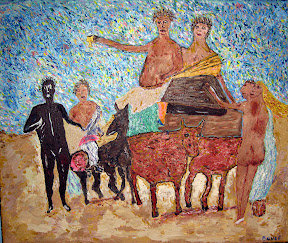
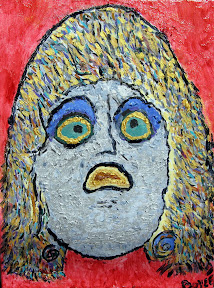
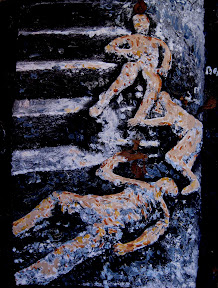
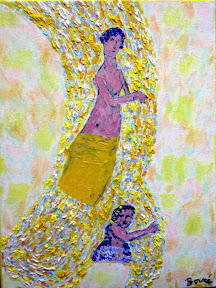
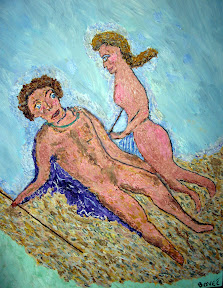
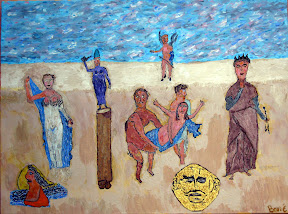
NEW ART FROM CLAUDE BOVEE!

The Triumph of Bacchus XI


Comic Mask


Tragic Mask


Victims of Vesuvius


Venus of the Fountain


Pyramus & Thisbe


The Sacrifice of Iphigenia

Tuesday, February 20, 2007

CLAUDE BOVEÉ`S 2006 PRIMO-GOLDEN-ACADEMY-CANNES-SUNDANCE-GLOBE-AWARDS-PART I


INTRODUCTION

2006 was one of the finest years for film that I have seen in a long time. I like unusual content, or stories that deal with new themes, not too terribly touched on in other films, and this is exactly the hand of cards that I was dealt. “Heading South” deals with the touchy topic of older women seeking secular pleasure, fishing for younger men in the exotic tropics of Haiti in the late 1970s, and this is disquieting…worrisome. “The Descent” is an all-lady horror film that is Sigmund Freud, Pandora`s Box, “Journey to the Center of the Earth”, and precisely Sam Raimi`s “The Evil Dead” all tied up neatly in one little bundle-it packs power punch and the audience was squealing, mewing, or belching in disbelief! Some of the ladies morph to flapping slabs of buffalo meat twitching in the cavern breezes, and this fills you with frightful foreboding! “The Children of Men” is laden with flashes of the past, and millenarian epiphanies…the simulated footage of a besieged present-day London (although it is fiction) is a sobering (or alternatively intoxicating) eye-opener.

I also love to go to the movie houses that show these gems, especially the Arbor, Dobie, and The Gateway. The crowds are getting bigger at the Arbor with its emphasis on Independent Films. The Egyptian Room at Dobie teleports you out-of-here and the strung out ticket girls with the minimum wage elicit sympathy, eliciting the recollections of friends who twinkled in the spitting image of this early stage of life. I lived at Dobie my freshman year at UT, and feel like I am nineteen again whenever I go there-not a bad state-of-mind for these dinosaur bones of time immemorial! I feel free as a bird when I am at the spacious, stress-reducing Regal Metropolitan 14. The Gateway is a second home…I always go to the Whole Foods Arboritum for lunch-local art work at luncheonette and my favorite check-out lady, Eryn (she actually asks me how I am doing)…a little crush, but merely afternoon fodder for fantasy! Just being treated respectfully goes a long way, people! Those instances are sensational seagulls in celebrations supercilious, seemingly in steamy scenic sammy sands stupendous insteeds…simple says of sunny Sally on the seashore with sandy seashells in September (or something as such).

I love to write about movies too; this helps me remember them better, then they become a permanent part of my cerebral landscape. This is how Francois Truffaunt and Jean-Luc Godard had emerged, from criticism to actual cinema making; then they created a new angle for French cinema, which comes with the moniker of the New Wave. The presence of these pioneers is expressed in the use of a hand-held camera in “The Children of Men”, by way of live combat footage. Too, in “Lower City” you are right on top of sweating, panting, and fist swings. As I got to the end, I wrote stream-of-consciousness fragments, ala Bob Dylan`s early album liner-notes. Loved reading millions of reviews on Rotten Tomatoes…the critics are stars too! I`m drifting on a float log…uh oh…

Been strung out…stuck in a pipedream, pitching horseshoes as a Saturday matinee…perched in a crows-nest, frothing at the mouth like Julius Caesar on the Rubicon…dancing in the desert with Jim Morrison, flickering footage of Gloria Swanson, tap-dancing on a surreal ceiling like Freddie The Freeloader hop-floppin`…cackling & cooing, balking & pawing at the air all primitive, pummeled & proper…praying to an illusive Oscar icon in a daydream stupor…pecking characters with no connection, stock-verbage…syllables, vowels, dangling participles, fragments, filler, pulp, poo-pooing `dis & `dat! Checkin` out the Paramount in the 1930s…D.W. Griffith in a jumpsuit, Klansmen racing by or the chariots of Ben Hur…there`s popcorn, peanuts, and candy-coated snacks, bubble gum smacking or corn dog crunching…previews, reviews, deviews, interviews, catalogs, indexes, newspapers galore, magazines, moviezines, polaroids for promotion, blogs or foggy hogs on bogs with frogs and dogs in cogs…tailbone sore, elbows crabby, Mack the Maggie makes moonshine whiskey?...two in the room and four on Netflix…(I`m getting to the end of a nightmare rainbow with Edgar Allen Poe laughing in the wind…)


1. The Children of Men ***** (Five Stars)
Does it sound familiar where Homeland Security is controlling a country ? The security guards are surely plastic-faced-mannequins, Nazi-like robots that kick and bully minority people about. Immigrants are placed in security camps, and the elderly are encouraged to commit suicide. Director Alfonso Cuarón adds a modern touch to P.D. James novel, but some points were lost in the film. You should read Caryn James piece in the NYTs piece from December 28th. It is a five star film because the nature of the totalitarian regime is explored creatively, and by comparison you may recall George Romero`s recent “Land of the Dead”, which treats this issue similarly, and where the crazy social and political landscape is clearly delineated, with proper quarters for the wealthy and repugnant dwellings for the doomed zombies.

Yet the odd theme of a world without babies anymore is more carefully treated on than the tenuous social fabric of England in 2027, and much of the footage is devoted to Theo (Clive Owen) toting Klee (Claire Hope-Ashitey) around and protecting her, since she is with child. Yet this provides fodder for the political uprising against the Regime, expressed with raging handgun and tank battles by The Regime against the insurgents. The mother Klee with baby is an obvious Virgin and Child image/reference, and when they peacefully exit the ramparts, this symbolizes the new age of The People emerging from the Dark Ages. Some of the hand-held camera shots are so intense that you can feel and hear the bullets whiz pass your head! The footage is so real, that you feel as if you are inside virtual historical events! Eerily, you sense that you are in your present environment, but transformed by events such as the civil war in Iraq. Strokes of Stanley Kubrick`s “A Clockwork Orange” beam through when Theo talks with Nigel (Danny Huston) about getting visa-papers for his ex-wife`s (Julianne Moore) nasty little revolutionary group. Nigel is the protector of art masterpieces such as Picasso`s Guernica or Michelangelo`s mangled David; he appears to be a mere opportunist who is simply taking advantage of the precarious political fractures. Oddly, the robberies of the Baghdad Museum around the time of The Invasion a few years ago were coming to my mind, as I watched in amazement with a nearly full-house of people at Westgate Cinema.

Michael Caine `s role as Jasper, a has been hippie, perhaps the last living remnant of the now remote 60`s culture, is my favorite with his strawberry pot, Beatles` music, free-form survival in a now totalitarian state. He represents the last whisper of humanity and Theo clings to him for solutions to preserve the human race via the pregnant, virginal Klee. The retro-hippie ephemera (hookas, pot-pipes, stereos, psychedelic/mod threads, and/or pop-posters) are profoundly preserved in Jasper`s pad, and I found myself ogling his domicile as if it were a museum of my youth (it made me feel somewhat old, and Michael Caine looked like a Howard Hues hippie-perhaps a shadow of `is actual self)!

I am going to take a little side trip here, but only because I believe that it will improve your understanding of this Orwellian movie. On the way to visit his cousin (Danny Huston), Theo winds through the gossamer streets of London, as he intends to secure clearance papers at the behest of his ex-wife (Julianne Moore) who is a revolutionary who seeks asylum for the only pregnant woman in the world, Klee. Interesting, is the fact that in the P. D. James novel, the cousin is actually the totalitarian leader, but in the movie, he is a sagacious, minister of culture, or something like that. Needless to say, the scenes with Guernica and David are intensely striking. The music playing over Theo`s travels to his cousins, is The Court of The Crimson King by King Crimson. I felt like I had been transported back in time to 1969, as this film so superbly intertwines the dying past tradition with newly emerging oppressive policies of the New Regime. I`m going to reprint the lyrics to the song here, with due respect to Robert Fripp and company, because they are all about the hoax of totalitarianism, and recall George Orwell`s “Animal Farm” and “1984”, just as the movie does. Maybe Cuarón had that in mind when he chose this track-all I know is that it is a tight fit!

THE COURT OF THE CRIMSON KING including THE RETURN OF THE FIRE WITCH and THE DANCE OF THE PUPPETS
(McDonald-Sinfield)

The rusted chains of prison moons
Are shattered by the sun.
I walk a road, horizons change
The tournament`s begun.
The purple piper plays his tune,
The choir softly sing;
Three lullabies in an ancient tongue,
For the court of the crimson king.

The keeper of the city keys
Put shutters on the dreams.
I wait outside the pilgrim`s door
With insufficient schemes.
The black queen chants
The funeral march,
The cracked brass bells will ring;
To summon back the fire witch
To the court of the crimson king.

The gardener plants an evergreen
Whilst trampling on a flower.
I chase the wind of prism ship
To taste the sweet and sour.
The pattern juggler lifts his hand;
The orchestra begins.
As slowly turns the grinding wheel
In the court of the crimson king.

On soft grey mornings widows cry,
The wise men share a joke;
I run to grasp diving signs
To satisfy the hoax.
The yellow jester does not play
But gently pulls the strings
And smiles as the puppets dance
In the court of the crimson king.
The smoldering dream of freedom is captured nicely through Michael Caine`s character Jasper, as he still clings to the past, and I did that too as I watched reality-like society of London via 2027.

Blood rack barbed wire, Politicians` funeral pyre, Innocents raped with napalm fire, Twenty first century schizoid man.


2. Lower City ****3/4
“Cidade Baixa” is replete with Brazilian viscosity and gusto-it`s on fire like a Mexican pizza, and heaves or pants, oozes and boozes-sweating from every pore common life in Bahia. The director, Sérgio Machado and the cinematographer, Toca Seabra were inspired by the photographer Mário Cravo and his book “Laróyé”, for its poignant look of street scenes and the people of Bahia. This is their model for “Lower City”; I did not see it at first, but the organic touch to this portrayal makes it fresh and different-this is why it is my second favorite for 2006. The more obvious reason is the sizzling persona of Alice Braga as Karinna. She struts, she prances, she promenades, she whips and drips-purrs and pulsates across the frames. Felt like I was burning dough-Waffle House hotcakes on a steamy skillet! The sprinkle of images makes this a unique cinematic experience.

A Cuba Libre at the Xanadoo for Karinna… skimpy orange halter-top… neon, strobes, and a rainbow jukebox…muscle shirts soaked in blood…cigarettes and longnecks…beer, beer, beer…nautical gear and ocean foam…homo-erotic backwash…liquor posters…dangling half-moon earrings on Latin señoritas…gritty interiors of dilapidated flats…tiny tiendas…50 just for the basics…panoramic sunsets…ocean foam and coetus…deep blue halter-tops, skin tight blue jean shorts, miniskirts that bark at you…bloody cock fights…bottles of beer…liquor set-ups…ciggy drags on chapped lips, on sweaty faces…sweat, sweat, sweat…orange lip gloss…chatty Portuguese…blue eyeliner, knock out bump and grind…fishermens` nets, pier coasting, tricks and scams…sways and moves, back-shots, front shots, dancing and swaying to the disco…stucco/plaster walls, pealing paint…shadows, alleys, chumsville…Hotel Paraiso…a pregnant Karinna..job: a dancer…pharmaceutical stickups…Brazilian guitar tracks (music is by Carlinhos Brown and Beto Villares)…cabaret scene-let your hair down, mixing and dancing…strip pole scenes in azure blue strobes, body glitter with starry backdrops…the blonde volcano…oodles of lust, tons of it…a john suicide, cop trouble, boxing matches, cantina gastronomical delight…long shots of the slums of Salvador…passion, jealousy, violence…a ménage a trois gone south…a bitter rumble, nursing, then an empty ending, camera right on top of flesh against pensive guitar riffs …


This is a tale of two close friends who have a baitskiff called Danny Boy and are hauling cargo down the coast of Brazil to Salvador de Bahia. They pick up Karinna (Alice Braga) who pays them back in kinky kind for the lift. Along the way there is a cock fight, a knifing, then a struggle to bring Naldinho (Wagner Moura) back to good health. Deco and Karinna harvest a tempestuous thing.In Salvador de Bahia (lower city) Nandinho morphs to street crime, and Deco resumes his boxing career. Karinna works in a strip club and continues a mere loose connection with the two boat dudes. Boy, Alice Braga has those little girl lost looks down pat… “if looks could kill they probably will with games without frontiers, world without fears…she`s so popular (repeat-Peter Gabriel)”!

This is a working class “Jules and Jim”, it does parallel those plot lines, but some of the scenes are so steamy and the interior shots of low-down Brazilian bars so original and Expressionistic, that it became, in my mind, the most exhilarating cinematic experience for 2006 (this just changed)! I just read that Sérgio Machado, the director and writer of the screenplay, is from Salvador de Bahia, and this would tend to underscore the precision of the camera shots of the city-so intimate, earthy, that they draw you into the story, focusing on a sort of proletariat ambience. I was fulsomely waxing during the neon-lit bar scenes of the Xanadoo with cigarette circles and pole dancers…grungy criminal clientele, and the chilly siren Karinna with mellifluous goldilocks way curling and blue toenails. She is so icy and calculating, yet passionate-vivid close ups of the sweaty Alice Braga are collectible in most cinematic portfolios of some devotés extraordinaire .

3. Heading South ****1/2
It was refreshing to see the sunny, secluded tropical beaches of Haiti in “Heading South”. I was reminded of my vacation to the Bahamas in the early seventies, where natives combed around the sleepy beaches and tourists sipped umbrella garnished tropical drinks, in search of nothing in particular. Yes, the ambience of this film cemented it as nearly the best for 2006. The other thing was the very awkward revelations of women of “a certain age” in quest of sexual trophy boys in an escapist paradise. These roles were perfectly played by Charlotte Rampling as Ellen and Karen Young as Brenda. Throughout the film they each give autobiographical monologues that reveal their backgrounds, monotonous pasts, and motives for seeking tender Haitian flesh. Charlotte Rampling is so sharp and clear, that you suspect that she has actually experienced this rigmarole in real life. She has rationalized to the gills the perfection of this “mutiny On the Bounty” trip, only from the female point of view. Only later in the film after Legba is sought after by the thugs of Jean-Claude “Baby Doc” Duvalier, the corrupt ruler of Haiti in the late seventies.

I engaged in a bit of research on the modern history of Haiti, anxious to sketch in some color to the contours, and then the parts with Albert, the manager of the resort restaurant, became clearer, with his obvious hatred towards the pretentious and matronizing mamas on their whimsical flings. Too, Albert has contempt for Legba`s humiliating whoring at the behest of the Cinderella sister-like Ellen and Brenda. I went back over the heinous regimes of Francois Duvalier (Papa Doc) and his son Jean-Claude (Baby Doc) and did not like what I found out. Afterwards, the scenes of Legba running from the Tontons Macoute (Gustapo-like secret police) in poverty-stricken back alleys of Port-au-Prince made more sense, and contrasted sharply with the bucolic resort, a false Disneyland for American turistas. Also, I did not care for the position taken by the US in pampering and catering to the wicked Papa Doc and his corpulent offspring.

Charlotte Rampling`s performance is so superb, that I have been studying her filmography, and it is indeed vast, and will try to view many of her films over the next year. In fact, I just got through watching “The Night Porter” just today, and I remembered that an old friend of mine from Dallas had always praised that film as her all time favorite. This was my first viewing of it, and since it came out in 1974, I`m a little tardy, but she has been right all these years, it is a masterpiece! But there sure is a hell of a lot of S & M stuff in it, though! It is brilliant the way that she portrays Ellen`s absolute possession of Legba, just as if he is her own little personal slave. Later, when she realizes that he is being hunted by the Tontons Macoute, she displays perfect conscience and responsibility, maybe even suspicion of her own complicity. You will have to experience the way that she plays this role, I urge you to do so, as it is released on DVD now. You are lucky! I`ll probably take another look myself (is this Ellen someone who I knew in another life). The subject of boy-toys is a touchy one, and that is just a warning to you!

that feelings as Brenda describes her love for the 18 year old Legba, probably since such corruption on the part of a well-educated middle-class American lady is not just an easy scenario to digest. It is a little more apropos for the brittle Ellen, as the warped Wellesley school teacher, who lives off the fat of the “colonial exploitation” land.

4. Caché (Hidden) ****1/2
There is so much exquisite detail in here, that I went out and purchased the DVD at Waterloo (Saturday, 1/20/2007). I keep running the chapters back over again in search of the minutest fragment that will definitively reveal who the culprit is (the one sending Anne and Georges Laurent the spy videos).”Caché” is an old fashioned unsolved mystery, a story of a well-to-do Parisian couple who suddenly receive a videotape that just shows their townhouse under surveillance by a centrally positioned, anchored video camera. Roger Ebert pointed this out in a January 13, 2006 review, such that the hidden camera is so positioned in a stationary place, that it is hard to conceive why no one saw it, since the tape runs for more than two hours. This is another conundrum in the plot line. Throughout the film they keep receiving these videotapes, along with little drawings that have blood coming out of the mouths of the figures.
The footage of the mysterious videotapes gradually provides good evidence of the perpetrators, and leads Georges to a run-down-apartment building, and to an old acquaintance from his youth.

5. Little Children ****1/2
Hey, it blew me away! There are three interpretive factors that presaged my pedestal-imbuing applications to it in short order. It cleverly transcends either the comic or tragic moniker, but is rather both at the same time. Next, it is a scathing indictment of American Suburbia, one of my favorite themes, and recalls Mike Nichol`s “The Graduate”, that was released in 1967. Lastly, because of its rebellion against status-quo mores, it is erotic [especially because of Kate Winslet`s role as Sarah Pierce] in a Catholic kind-of-way (one has to only project Anne Bancroft removing the stocking).

Went back over many of Kate Winslett`s work…saw “Quills”, “All The Kings Men”, “The Life of David Gale” and really dug “The Constant Gardener”. Look out for the blue toenails in “Little Children”. She is able to alter her appearance from film to film, so that it takes some effort to recognize her.

Jackie Earle Haley plays Ronald James McGorvey, a convicted sex offender who gets out of jail, and returns to his former neighborhood and moves back in with his mother. Haley is up for an Oscar as best supporting actor in his riveting role as a blemish on this carbon of Boston suburbia, who is still struggling with demons, even as the chief characters Sarah and Brad wrestle with their own internal malignancies. This film is an exposé on the purging of character quandaries-this is manifested magnificently through Ronny, and genuinely in the closing sequence. Ron nobly attempts reform, and is encouraged to date by his mother, who has a charming collection of glass menageries-little children with grimacing faces. Furthermore, he is harassed relentlessly by Larry Hedges (Noah Emmerich), a retired cop with a few skeletons in his closet of his own.

6. The Departed ****1/4
Martin Scorsese begs the eternal/cosmic question, who is the rat…or do I smell a rat ?…if you will. Isn`t this really what we probe every day-either at work, with friends, and keenly with family. Who are our real allies-our commitments, our loyalties? This is
explored in “The Departed” via the Irish Mafia and through the State Police in Boston. Absolutely, “The Departed” sizzles, it pops, it ricochets, it sears, it smolders, it explodes, it`s historical/fictional, it`s anti-crook/anti-cop, it balloons, it cascades and descends, it`s with crescendos and valleys…and it has the Rolling Stones` “Gimme Shelter” coming up against the gratuitous take-outs of Frank Castello`s Murder Incorporated. I stood up in my seat with startling chills as the voice over of Frank Castello says “when you`re facing a loaded gun, what difference does it make.” This is really a study of when cops go underground (Leonardo DiCaprio), and when crooks go undercover (Matt Damon) as well, they impersonate or morph into the bad guys-just think of “Donny Brasco” and you will get the picture. I went to see it again yesterday (1/27/2007), simply because the dialogue is so crisp (think Mark Wahlberg) and the action so fast, that I know I missed a lifetime of connections the first time around. Also, I am filled with religion and furthermore convinced that Martin Scorsese should get the Oscar for best director (and I hope it gets best picture as well).

The all-star cast works harmoniously together-I was stunned by the demise of Martin Sheen and Alec Baldwin a very convincing cop. Matt Damon plays a perfectly sly villain, but Mark Wahlberg sees the writing on the wall. Jack Nicholson is as atrocious as would be required of him, and Leonardo is bristlingly balanced, a cocktail of good and evil. Vera Farmiga is surprisingly fresh and I was reminded of Lorraine Bracco in “Goodfellas”. Joe Pesci and Robert De Niro were sorely missed, as well as Ray Liotta for sure! But it was different picture, different scene, different cast…and that is good!

Marty is back in full force, right in there with “Casino” and “Goodfellas”. The only thing missing is Robert and Joe. The rapid street dialogue and the sharp editing is the best I have ever seen. The action is swift as corpses keep popping up here and there. And once again, violence and rock and roll are perfectly fused in that volatile concoction that forces you to stay edgy and nervous, anxiously awaiting the next cracking bone, hidden switchblade, or crackling revolver! Take the scene where Jack Nicholson pulls out that blue, bloody, severed hand; you drip beads of perspiration that go dribbling down the back of your neck, and you wince when Frank Castello praises John Lennon as an artist. Once again, the tones of the Rolling Stones come wafting out of the speakers…( blades and gunshots radiate from the screen)”Oh sister, it`s just a shot away, it`s just a shot away!”, and even John Lennon`s “Well, Well, Well” is dubbed over the ruckus surprisingly synched . Guiltily, you know that you went to the theater to see the action, but you deny it in your brain, and try to say to yourself that it will just be another “Aviator”. The inside joke on the last scene is the sickest, most ironic, and the cleverest little metaphor that I have ever been privy to!

7. Babel ****
“Babel” is four seemingly disconnected vignettes all packaged together under one roll of celluloid. Veteran filmgoers quickly reference “Crash” or even to a greater extent, Godfrey Reggio`s 1982 “Koyaanisqatsi”, which paints a broad brushstroke of omniscience, apocalyptic disruptions, and peeks into the global village. As “Babel” progresses, skinny threads tether the disparate plot-flourishes with microscopic bits of connectivity. This world philosophy of random events, like moving balls on a pool table, that tend to have durable consequences, is an overarching undercurrent of this very cool film from Alejandro Gonzáles Iñárritu. This is more coherent, a more exquisite gem than “21 Grams”, which plays tricks with time, to the tune of Chicago`s “Does Anyone Really Know What Time It Is?”, figuratively, of course.

The soundtrack, which I made a beeline to Waterloo to pick up after seeing the film, really ties the entire globalized trip together. The soundtrack was created by Gustavo Santaolalla, and has sounds from around the world, and smartly includes Earth, Wind, and Fire`s catchy “September”. The main theme, “Bibo No Aozora” is really haunting. “Cumbia Sobre El Rio” written by Gildaro Montoya Ortiz” perfectly captures the ambience of the Mexican-American border, with its classic voice-over echoes; I should know, `cuz I`ve been on the border many times. The music compliments the somber mood of the disparate plots, and you tend to dwell more on the feel of what is happening, not the mechanics of the story. The feel is the key to this film.

8. Volver ****
“Volver” is way, way Spanish! That`s what makes it so good! Penelope Cruz as Raimunda looks so ravishing in this film, that not much else seems to matter. The birds-eye shots of her cleavage as well as the promotional shots of her in that low-cut red-striped shirt pretty much grabbed my attention and kept me focused throughout the duration of the flick. Yes, the longing for Cruz-cleavage kept me glued to my theater chair like a thirty day old slab of bubble gum! (A little bit of honesty may go a long way with these words.) I had seen Pedro Almodovar`s “Bad Education”, but that was a convoluted, sickly sweet study of catholicism, from what little I can remember of it. “Volver” is about the maternal secrets of Irene (Carmen Maura) and the way that they were hidden through the years, as well as there significance to her daughters Raimunda (Penelope Cruz) and Sole (Lola Duenas). This one is very wholesome in an odd kind of way. It seems to be about the survival of ladies in Madrid through resourcefulness. The plot keeps getting thicker and richer, more Spanish cultural traditions go a long way; finally the puzzle pieces are carefully put in place right at the end.

9. The Queen ****
“The Queen” really rocks! Helen Mirren certainly will cinch the academy award for best actress. Playing the role of Queen Elizabeth, she clings to the dying institutions of the monarchy, as Tony Blair (Michael Sheen) gains a resounding majority of the British constituency. The dynamics of political power are revealed against the tragic car accident of Princess Diana in 1997. This film is a docu-drama cleverly blending actual footage of the events with interpretations of the Queen and her entourage, as well as the Prime Minister and his retenue`s reactions to Diana`s death. The Queen`s crew are stowed away on summer retreat at Balmoral Castle in Scotland. Britains are very angry with them for not coming back to Buckingham Palace for the ceremonial grieving. Tony Blair has to summon the Queen back by decree to offer a statement of condolence to a boilingly livid populace.

The royal family dwells in a bubble of the past with the senile Queen Mum (Sylvia Syms) refining her funeral plans, and Prince Philip bragging of the five-point stag running free on the grounds of Balmoral, or offering The Queen mother`s little helpers to assuage her nerves after Diana`s car wreck.

All of this is really about the changing of the guards, about a shift in power from the Windsor royalty to the Prime Minister Tony Blair. More specifically, the embracing of democracy by the British citizenry, and the jettisoning of the rusty relics of the monarchy are the business of this enterprise. This is the painful drama of that unraveling process. And it is really Diana that provides the crack in the platform. She is “The Peoples Princess”, and appeals to common people.

I could not quite put my finger on why this film worked so well. Then bingo, it dawned on me! “The Queen” plays as a metaphor to real life, the struggle between those who cling to the past, and the bold few who see the writing on the wall-that recognize that change will be necessary to solve so many problems-political, social, or personal.

10. Sophie Scholl: The Final days ***3/4
I saw this film in May of 2006 at Dobie; that was the first time that I had ever heard the story, and I was touched by Sophie`s courage. From what I could glean from reading Ed Ward`s blog, East Germany has been experiencing a slow thaw after the Berlin Wall was dissembled, and some new documents have come to light that include the interrogations by the Gestapo of Sophie Scholl and her distribution of the fifth leaflet of the White Rose. These documents provide the basis for this compelling docu-drama of acts of bravery on the part of these German youths. Julia Jentsch plays Sophie and Alexander Held plays the Gestapo interrogator. These are the principle roles and also account for the high integrity of the film. A couple of critics have compared Sophie to Joan of Arc, and this rings true as she is a martyr for freedom. She pointed out that the judge may be in her shoes shortly. This actually comes about with Nuremberg, the trial where so many Nazis were exposed and condemned to death. One critic compared her to Sir Thomas Moore, as portrayed in “A Man of All Seasons”. This is an apt comparison, and I thought of Anne Frank too and her uncharacteristic optimism when the Gestapo was hunting down her Jewish family .

The sets were stark and the movie just covered the five days until her execution on February 22, 1943. This gave it a sober, political realism, and a no fooling around presence. Julia Jentsch as Sophie Scholl remains noble, saintly, and with a youthful halo of idealism throughout the ordeal. You sympathize with her to the umpteenth degree and you loath the Gustapo agent Robert Mohr, equally as much as you love Sophie. With rapid prosecution, her execution came on the same day as her trial, although I suppose that was protocol for this fascist regime. Sophie Scholl`s final words were: “The sun still shines”, so she remained gleeful until the end. The moral of this story is an important one, that some brave individuals will still dissent in the face of stupid, freedom-bashing policies. This message must continue to resound with regard to the current Patriot Act as well as to the wire-tapping policies of the Bush Administration; these enactments move us backwards, and into darkness, back to the days of the fascist fallacies of Hitler`s Third Reich.

11. The Painted Veil ***3/4
The most obvious virtue of “The Painted Veil” is the visual splendor of the sets, and the fact that it was actually shot in China. The cinematographer was Stuart Dryburgh and he did a terrific job in the final print that was produced. Apparently much of it was filmed in Guangxi Province, and Huang Yao, an 800 year old town. Many scenes look like oil landscapes and many of the scenes are picture postcards with the misty mountains, glistening water, and the parasol- twirling Naomi Watts in the foreground. One may fancy a viewing of the movie just to inspect these stunning scenes of China.

Once again, Edward Norton, my favorite living actor, does an outstanding job playing the stodgy Walter Fane, a bacteriologist. I kept expecting him to morph evil, but instead, he morphed virtuous. Naomi Watts played Kitty (she works well with director John Curran as she did in “Does Anybody Live Here Anymore?”), and transformed from a mischievous aristocratic brat to a Sister Theresa, performing as a pianist to the local orphans of a French convent (be sure and check out Diana Rigg as the Mother Superior). Toby Jones played the foreign diplomat Waddington nicely, as a true friend to Walter and Kitty in an increasingly hostile atmosphere towards Westerners in China ala mid-1920s.

12. The Bridesmaid ***1/2
This is French filmmaker Claude Chabrol`s 54th film, and he confidently tells us the story of Philippe, played by Benoit Magimel, who sells plumbing contracts by day and caresses a bust of Flora by night. When his sister (Anna Mihalcea) marries he meets Senta, played by Laura Smet, and swiftly begins a liason with Senta, a crafty siren-fabling witch of sorts. It seems as if everything coming out of her mouth is a lie, but it is mostly charming tall tales, such as she has been in a Woody Allen film, or in important theater productions, and has even worked as a stripper and an escort girl. Laura Smet has cat-like eyes that besmack of evil, and she is a femme fatale of the highest caliber as Senta in this French psycho-sexual thriller.

There are various subplots, that underscore Chabrol`s recurring theme of the demise of the bourgeoisie, such as the mother Christine`s (Aurore Clement) failed relationship with the flighty Gerard (Bernard Le Coq). Too, Philippe`s sister, Sophie (Solene Bouton) sinks into drugs and shoplifting. But really, the dark-side-focused bridesmaid, Senta, and Philippe`s curiosity about her, is the central brainteaser, and blitzkriegs us through the second half of the film. Senta alludes to the fact that they are destined to be joined. She then proposes to him that real lovers will perform four things. They will plant a tree. They will write a poem. They will make love with a person of the same sex. And they will each kill a perfect stranger. What happens as a consequence of this proposal is the spin of this tale. Suffice it to say the conclusion is very shocking, even though you suspect that it will be. “The Bridesmaid” does not disappoint, so be sure you see it.

13. The Night Listener ***1/4
This did not receive very good reviews, but it is perfectly suited for a Netflix top-pick queue, seeing how not many people actually witnessed the film at the theater. Hey, I really got into it, and thought of it as a mood piece, and was really impressed with Toni Collette as the protective adopted mother to the rampaged AIDS youth, Pete (Rory Culkin). Robin Williams, as the writer and radio show host Gabriel Noone, is serious and frothy, a convincing character actor, as he pursues the integrity of the “Pete Story”. This is the best picture Robin Williams has ever done along with Robert Altman`s “Popeye”, as the plot drifts into a Freudian study of loneliness and unfulfilled human desires that tend to go south into sickoland! The sets are desolate, the soundtrack morbid, and the lighting dim. The Night Listener explores the dark and naked side of the psyche, just shy of noir, and Toni Collette steals the show as a darkly dame drifting dissonantly into never-never-land! I am just now seeing her performance in “Little Miss Sunshine” -(1/31/2007-I took three days to watch the Netflix selection. Just today-2/10/2007- I saw her in “The Dead Girl, and Toni plays another oddball that finds the body). But “The Night Listener” is anti-high-definition viewing, a bleak, grey gut-shot of isolationism and the delusions of a lost soul!

14. Bobby ***
A CIA hit team takes Bobby out and uses Sirhan as the robot-pansy-patsy! RFK was shot in the back of the head, so it had to be someone else! Read Shane O`Sullivan`s piece from 11/20/2006 in The Guardian…he is onto something. Cascading into the labyrinth of what really happened-the more dangerous path… Why were CIA operatives at the Ambassador Hotel-including David Sanchez Morales? The LAPD knew about it, but chose to cover it up. The gunshot wound had powder burns, thus proving that the muzzle of the gun was put right on RFK`s head. Therefore, Sirhan could not have done it-period.

A crusade against organized crime…confronting J. Edgar Hoover, a legal mob boss…the cornering of Jimmy Hoffa…the desegregation of Old Dixie…Civil Rights advocate bar none…in 1962 U.S. Marshals to Oxford, Mississippi-James Meredith is in…then the Civil Rights act of 1964… “but suppose God is black?”…RFK saved our butts in the Cuban Missile Crisis…”Each time a man stands up for an ideal, or acts to improve the lot of others, or strikes out against injustice, he sends forth a tiny ripple of hope…” The War on Poverty and the end of the escalation of the Vietnam War…champion of the disaffected, impoverished, the excluded…this country is on a perilous course…LBJ drops out and Bobby is raised to the tragic stage… “My brother need not be idealized, or enlarged in death beyond what he was in life, to be remembered simply as a good and decent man, who saw wrong and tried to right it, saw suffering and tried to heal it, saw war and tried to stop it” (Teddy). I weep copious tears, am racked with agony and sorrow for the Kennedys, the doomed Irish clan from Massachusetts. RFK improved The World, the plight of blacks, the disenfranchised, pacifists, white trash, hippies, fruit pickers, Native Americans, kitchen help, alchies, pill-poppers, rackateers, mal-nourished, immigrants, the youth movement, South Africans etc, and paid the ultimate price when he was gunned-down by a CIA hit squad…you know it`s true, I know, but it will be eternally buried in time by the evil purveyors, that pull the puppet-strings, that write the college textbooks of history…we are no different than Stalin or Mao…maybe even more evil, since we protect the hoax of freedom…

Emilio Estevez is trying to pull off one of those cosmic-historical films, like say JFK by Oliver Stone, and it is diced onions all the way, or say a very spicy cup of tea (or maybe even electric koolaid) for even the greatest, such as Cecil B. DeMille! Nonetheless, I just love to go back in a time machine to the year 1968, `cuz then I feel a swirl of vibrating- love again! This all-star cast really rocks, and there are some actual LSD acid trips in the film! Demi Moore stands out the sharpest as the alcoholic, washed-up diva-torch singer with the fluffy black wig. Footage of RFK still breaks your heart, as you are reminded of the crushed idealism of perhaps the most inspirational politician of the twentieth-century!
When I was a kid my family went on vacation to Washington DC in the summer of 1964. We visited the Attorney General`s office and actually met Bobby and chatted with him but briefly, and he autographed his book Thirteen Days, about the Cuban Missile Crisis, for us. I personally experienced the sorrow when he was shot. (This was an ill-remembered incident. Yes, a delusion, that never happened…I must have dreamed it though…why do I remember it perfectly as a real event…déjà vu I suppose?)

15. The Illusionist ***
This is a period piece that takes place in Vienna in 1890-the age of Freud, Mahler, and Queen Victoria. This current year (2006) has been a good one for magician movies; just think of “The Prestige”, and this one (The Illusionist) has some startling tricks in it as well, and a panorama of a tangled-tale with a surprising ending. Paul Giamatti is the glue as the Inspector and narrator, and Edward Norton is all mysterious and dazzling as Eisenheim the Magician. Birds turn into butterflies, red balls are suspended in space, and ladies return from the dead in this spectacle of Victorian hocus-pocus!

Serious mood piece…1890s Vienna ambience…Harry Houdini but Edward Norton with a V-shaped beard…reanimation of Sophie von Teschen…conspiracies of Prince Leopold…humiliation of the Crown Prince via Eisenheim`s magic Arthurian sword-in-the-stone…atmospheric Philip Glass soundtrack…perfect period sets…Uhl (Paul Giamatti) is the narrator, who is party to the Prince, but is awestruck by Eisenheim…cross-class romance and Freud jumps up from the grave…supernatural power magician flick!...better than Tony Curtis as Houdini, Orson Welles in “Follow The Boys”, or Vincent Price-3-D “The Mad Magician”…best magician flick ever!...

16. An Inconvenient Truth ***
Al Gore brought the case of global warming to the people in this educational film, and may have made a vital contribution to the Democrats convincing victory in the fall. The visuals are helpful in seeing exactly how our environment is going down the tubes.
I heard yesterday (1/24/2007) that “An Inconvenient Truth” was nominated for an Academy Award in the category of documentary. I was glad to hear this, and I certainly hope that it wins. I read Roger Ebert`s review from June 2, 2006, and was astounded at what a strong endorsement he gave (it is on Rotten Tomatoes-and no, I am not including hyperlinks in this best of). Global warming is in the news right now, and Al Gore has obviously shown leadership in bringing this issue to the forefront. It was just announced that Al has been nominated for a Nobel Peace Prize (I heard about it on February 1st). From everything that I have seen, global warming is impacting us right now in Austin! We will need to address these issues right now, or we will perish as a world!

17. Marie Antoinette **3/4
“Marie Antoinette” is just a big birthday bash with pretty deli-trays, period costumes, and Mademoiselle set designs that are the frothiest photo-ops this side of Paris. This is a great big slab of baklava-that is perfectly fine too! Sophia Copola thought more in terms of style-clothing, food, buildings, and etiquette in this quality-treatment of the doomed French queen. Makes you want to collect all things about Marie-truffles, blouses, or girdles. You are certain to get the munchies for French pastries, and some of those sets were pieces of pop-art ala Richard Hamilton!

A few fatal errors-no guillotine scene was ever shone! This is simply unforgivable. Also, Sophia is anti-historical, but had she been historical, this against punky tracks like Bow Wow Wow`s “I Want Candy” would have been groovier. Still I did like the New Wave music, even though it was a blatant malapropism. The movie included really arty set designs, beautiful displays of French pastries, and photo-ops for designer magazines. This was alright by me, but this was not a serious treatise on the quixotic historical personage, Marie Antoinette. You would best be served by the two volume treatise by Georges Lefebre “The French Revolution”, if you really want to know what is going on. Lefebre has a Marxist take on the period and so it`s the bourgeois phase of the revolution-pre-proletariat and post-aristocracy. The Red Queen said, “Off with her head”, so it is back to the drawing board for Sophia Copola.

18.The House of Sand **3/4
As a barren epic that takes place in Northern Brazil from 1910 to 1969, the camera captures the white sand dunes, beaches, and livestock of Brazil nicely. This is just a survival story and the possession of a meaningless piece of real estate, a tiny fragment of sand, other than the fact that it is these ladies (Fernanda Montenegro & Fernanda Torres) sole source of existence. As you watch it, you just keep hoping that the women can some how make it, just as in your own life.

19. The Descent **1/2
A quintessential anti-chick flick that really drags you through the mud with lady victims. Makes you want to never go camping again. Really great caves and scary nightie-mole-monsters. There are no detectable ethics here, just gratuitous violence, and the Generation Z audience was constantly guffawing and grimacing…anticipating the next girly slam. The mole-people are very scary, but are merely props for sequential babe-bashing a-la-the “Friday the Thirteenth” serials.

The scenes carefully build as the women plan their climb into the womb of the Appalachians, apparently into uncharted caves, off the map, and fully out-of-this-world!
For myself, I will have to collect “The Descent” like I did recently with “Slither”, especially for viewing during the latter half of October-you know, the season of the witch.

20. The Quiet **
Elisha Cuthbert (do not forget her great performance in “House of Wax”), as Nina Deere, really sports a blonde wig well in this twisted, “Rock and Roll High School”-spitting mirror image, Burnt Orange Production. “The Quiet” offers up a hot donut of a fresh take on familiar teenage problemas, such as dating in high school, valley girl buddy charades, awkward family dinners (I was reminded of the lumpy familial dinner scene in “Little Miss Sunshine”), drug use, and even sexual abuse by a flat, two-dimensional father. A tangy twist of lime and a sexy saga of incest and bikinis, breaking out of social molds, and beaucoup fowl language, “The Quiet” takes you down Leave To Beaver lane, but drops you off in a secluded, demon infested alley. Surprising plot twists are rampant, and a flawless, yet flawed Edie Falco plays a dynamically dysfunctional mother, ruled by mother`s little helpers. This is an over-the-top role for her, and it looks as if she is really getting into it. It`s as if Edie had studied Jacqueline Susan`s “Valley Of the Dolls” and was given an opportunity to promenade some of Jacqueline`s pill popping big mama stuff! It is in a very bleached technicolor, almost black and white, and is a prodigal daughter to the drive-in rebellion films of the 1960s. With the recent popularity of old, low-budget noir, especially in San Francisco (this will probably shimmy out to other progressive burgesses), “The Quiet” fits like a moldy glove on the stump of a post drive-in film world!

Sunday, April 16, 2006

Fra Angelico

PART III-THE ANNUNCIATION
In the sixth month the angel Gabriel was sent by God to a town in Galilee called Nazareth, to a Virgin engaged to a man whose name was Joseph, of the house of David. The Virgin`s name was Mary. And he came to her and said, "Greetings, favored one! The Lord is with you." But she was much perplexed by his words and pondered what sort of greeting this might be. The angel said to her, "Do not be afraid, Mary, for you have favor with God. And now, you will conceive in your womb and bear a son, and you will name him Jesus. He will be great, and will be called the Son of the Most High, and the Lord God will give him the throne of his ancestor David. He will reign over the house of Jacob forever, and of his kingdom there will be no end." LUKE 1: 26-33

First, I will cede a mere modicum of divers postulations or anomalies, in order to give you better acumen as to my presence of mind. The story of the Annunciation is only told in the book of Luke, yet the portrayal of the Annunciation subject in art is ubiquitous for the timeframe discussed herein, the late Medieval and early Renaissance periods in Italy. Someone had a clear motive to propitiate the firmness of this account. Next, Fra Angelico was under the spell of a furious blast of winds, the zephyrs of Catholicism, truly blown by the Mendicant orders, the Franciscan and Benedictine, the latter of which he was a member. Expeditiously, Fra Angelico is in some measure Gothic, but at the same time, a practitioner of new ideas, accrued from the fresh insights of Masaccio! (Please note that Lorenzo Monaco was his chief mentor). Contemporary scholarship on Beato (Angel), exclusively for the recent Metropolitan exhibition, has been made ready by Laurence Kanter, the chief art historian for this prodigious panoply. Essential to ones collection is Fra Angelico by Laurence Kanter and Pia Palladino, and published by The Metropolitan Museum of Art, New York and Yale University Press, New Haven and London. The principium of this text, and sharply in opposition to John Pope-Hennessy from the old school, is that Kanter upholds Fra Angelico`s position as an deviceful artist, in the Florentive Quattrocento, conspicuously after the death of Masaccio in 1428, and before the advent of Fra Filippo Lippi. Foremost, when I experienced this exhibition on December 27, 2005, and without herein unveiling indulgent rhapsodies, I was bestruck with its perfection and fragrance of beauty, never played back in prior romps! Beato had such a saintly inspired and steady hand! So delicate was his application of paint-zealously, I scrutinized the surfaces of these antiquated panels-that one may imagine that the temper paint was applied with a needle, rather than a brush! So with these theories as an underpinning, I will begin to mull over sundry executions of the Annunciation.

The earliest rendering of this subject by Fra Angelico was plausibly painted between 1413 and 1417 (see Laurence Kanter-pp. 22-24). It was done on two different panels, one as The Annunciatory Angel (11 3/8 x 12 ¼ in.) and one as The Virgin Annunciate (11 ¾ x 12 3/8 in.). In point of fact, I ogled these ethereal gems at the Metropolitan last December! Both are close models of Lorenzo Ghiberti`s bronze relief of the subject on the north door of the Baptistry in Florence. Even God the Father is shown in the top left hand corner of the Virgin piece with golden rays and the dove of the Holy Ghost. While the two medallion-like works are still primarily Gothic, the folds in the Virgin`s blue robes are true to nature. The wings of Gabriel are exquisitely articulated as he grasps a lily in his left hand. The Annunciation by Simone Martini painted some one-hundred years before, has a lily in Gabriel`s hand as well, yet it is the right hand. Angelico`s interpretation differs from Ghiberti`s in that the figures are discernible within the interior of the architectural structure. Throughout his tenure there is an apparent, increasing sculptural quality to his models-Donatello`s marbles and bronzes were very much an inspiration. The paint colors (tempera only) chosen are roses, blues, pinks, golds, and grays. Angelico employs bolder color choices than other artists from that time, with Lorenzo Monaco or Gentile da Fabriano as amenable guides. It is unknown what function the panels served, but they must have been part of a tabernacle or reliquary (Laurence Kanter-p. 23).

The two heavenly characters are also separated out in Giotto`s Annunciation, a most famous version in the Arena Chapel in Padua, painted around 1305, and not long after the chapel was built by its wealthy patron Scrovegni. Giotto`s Mary is matronly and more closely resembles an indigenous Italian of the Trecento. Angelico`s is to a greater extent innocent, perhaps younger, and more in tune with the other world. Duccio Buoninsegna`s Annunciation, in the National Gallery, London, and painted in Siena in the early Trecento, manifests a harbinger of modernity, with the central characters in motion, and a contemporary architectural backdrop. Duccio makes use of a lively application of color, and circumscribed command of the robes of Gabriel and Mary, in their shading and folds. Noteworthy too, are the mystical mastery of the vase of lilies and the descending dove of the Holy Spirit up in the arches. As to whether Fra Angelico ever saw Giotto or Duccio`s paintings, there is no surviving record, but it is believable that he did, when one examines his offerings.
I choose to discuss the next three principal versions of the Annunciation by Fra Angelico in ascending order (from the base of the mountain to its pinnacle), according to my predilection for the paintings. The Annunciation at the Museo Nacional del Prado, Madrid (1425-1426) is one piece associated with Fra Angelico`s early-middle period; that is, when he was still under the spell of Lorenzo Ghiberti and Gentile da Fabriano. He is especially informed by Fabriano in his use of color and his penchant for meticulous design. Please study Gentile da Fabriano`s perception of the Annunciation. It does appear as if Fra utilized Fabriano`s streaming diagonal beam of golden light, radiating from God. The small altarpiece for San Domenico at Fiesole by Fra Angelico is wrought with detail; just look at the Garden of Eden drama unfolding to the left side of the panel, with Adam and Eve, an angel, and vivid verdure coupled with the bountiful fruits of paradise. Moreover, there is much painstaking accessary in the Archangel`s wings and his gilded rose-colored garments. The edifice, enveloping Gabriel and Mary, and highlighting the miracle with tans and whites, exudes mathematical precision and harmony. Profoundly, Angelico projects out of the Gothic references of Fabriano and his recent past, and into the scientific cadences of a Fillippo Brunelleschi or a Ghiberti. Conjointly, observe the subtle shading of the back chamber behind Our Lady-perhaps the boudoir of the Virgin herself! Curiously examine the swallow (rondine) perched on an iron tie rod to the left, and just above the Virgin-no doubt, a pun referring to the patron Allessandro Rondinelli (Laurence Kanter-p. 83).
The real space depiction of the figures in its architectural context, as well as their more pronounced genuflection (Kanter`s word), is a departure from Fabriano`s mostly rigid models and flat spatial frame of reference. Both of the blessed models are humbly stooped, and their hands are folded in sacrosanct devotion. Their faces are gentle, soft, and rosily irreproachable, and magnanimous gilded halos radiate about their heads! Too, the draperies behind the Virgin echo the gold/ochre of Gabriel`s wings, as do the deep blues of her robe parallel in tone the upper arches cascading down to the columns. The pinks of the Virgin`s undergarments are appreciably lighter than the Archangel`s, and subtly act as bookends to the smaller angel in the paradise scene to the left of the panel.
The Annunciation altarpiece from the church of San Domenico in Cortona (1430 or 1431) is emblematic of the late-middle period of Fra Angelico. This stylistic shift is outlined by a pruning of excessive elements, along with a sharper focus on the thematic developing drama within the painting (Laurence Kanter-p. 24). That is, considerable more tribute is paid to Masaccio, who died in 1428 in Rome. Some of the cornerstones of Masaccio`s revolutionary vicissitudes include: figures that appear more sculpture-like (inspiration from Donatello), the depiction of real space, as it appears to the naked eye in nature, the use of foreshortening, the employment of chiaroscuro, and lastly, the simplification of particular peripheral elements. Moreover, a most significant breakthrough of Masaccio, is the illustration of personages in histrionic motion or expression. I am proffering, as an example, the Expulsion from the Garden of Eden, in the Brancacci Chapel, which is within the church of Santa Maria del Carmine in Florence. And without the differentiating flagrancy of a bellowing braggadocio, I had the charmed occasion to visit this church in October of 2000, and could give testimony firsthand to the salient qualities of Masaccio`s revelations of technique.

With these new forms at his disposal, Fra Angelico begins to give birth to a number of compositions that betoken this new late-middle period style. In order to better grasp Beato`s newly acquired synthesis of the modus operandi of the one gifted Masaccio, I beseech you to look at The Apostle Saint James the Greater Freeing the Magician Hermogenes, painted in the late 1430s.This piece is in the permanent collection of the Kimbell Art Museum in Fort Worth-I shall make a point to feast my eyes on it with flagitous fanfare! Its creation coincides with a contiguous date to the Cortona Annunciation, as the figures also betray emotive action in their drawing. So then, as a result of the lessons gleaned from Masaccio, one may observe how much more motion is detectable in the Archangel and Mary of the Cortona piece, than in the Prado painting of about five or six years before. True also, the clothing reveals Masaccio`s influence notably, with the judicious use of chiaroscuro, and in the delineation of the folds of say, Mary`s blue robe or the rose skirt of Gabriel. One befuddlement, since his late-middle period is primarily associated with a bereavement of excessive ephemera, i.e. in apparent contradistinction-yet oddly the gilded wings of Gabriel are considerably embellished and thus distinguished from earlier productions, and the golden throne is almost Byzantine, with its geometric ornamentation! This can be made plain, perhaps, by the fact that these delicate touches give credence to the central drama of the calling up of Mary. As a consequence, they are not mere incidental minutiae that cast the eye away from the substrative vision, but contribute to the cardinal proceedings of the pictorial narrative-this too would be in deference to Masaccio!
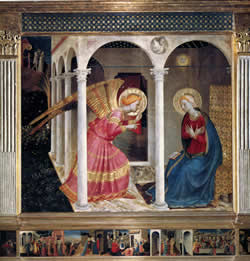
By way of comparison, the Deposition, originally in the sacristy of the Santa Trinita of Florence, is in like manner from Angelico`s middle period (early 1430s), and is stylistically aligned to the Cortona Annunciation (Laurence Kanter-p. 87). Further, the components of the Deposition are realistic, as in the wood grain of the cross, the lash wounds on Christ, the cypress trees, the city of Jerusalem, and as a final embroidery, the indigenous Florentine attire of the saints and sinners (Laurence Kanter-p. 87). The Adoration of the Magi by Gentile da Fabriano, finished in 1423, and in the same church, provides sustenance for Beato`s panoramic depiction of Christ`s removal from the cross (Laurence Kanter-p. 87). Both paintings are distinguished by jewel-like precision and are fairy-tale portrayals of two unique biblical events, construed, in both cases, with much detachment.
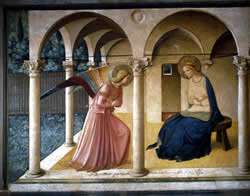
The last of Beato`s oeuvre that I will deliberate on, does emphatically bestow an optimum ravishment for my eyes, as do many of the frescoes from the Benedictine convent of San Marco in Florence. It is another Annunciation, painted in the 1440s, for the north corridor of the convent . The only other reference to the frescoes in San Marco that I can provide here, is Saint Dominic in Adoration before the Crucifix, that resides in the cloister of the convent, and is closest in style to the Annunciation. These two masterpieces, falling in the late years of his career, were painted by Beato only, as they reveal the hallmarks of his gentle hand. A considerable large quantity of these frescoes brandish the intervention of assistants (Laurence Kanter-pp. 184 and 185). This is primarily due to the fact that Fra Angelico depended on assistants to help him complete the considerable volume of work necessary to satisfy the demands of his patrons. Too, I am most fond of the fresco medium, and this contributes to my appreciation for this particular rendition. And another suggestion is the stark simplicity of this work, where ones eye is only focused on the blessed visitation of the Archangel Gabriel, as messenger, delivering the inevitable cosmic fate of the Virgin Mary.
Markedly, this painting is Masaccioesque-with the sweeping, agile genuflection of the models-they have body and presence, as they would in nature. Examine the Expulsion from Paradise to see how Masaccio captures Adam and Eve moving away in sorrow, after they have gravely disappointed their Maker! The stately edifice, in the San Marco fresco, is bathed in natural light, and this augments its religiosity and is proof of its simplicity; one can only see form in nature according to the conditions of light on that environment. This is a trait of Beato`s late phase, as he increasingly uses the effects of light on the models and the architecture; and this illumination as to the effects of light dictates his use of color, shading, and depth perception (Laurence Kanter-p. 184. note: some of this is my own idea). The cognition of the effects of light is an opulent divination for the Benedictine monk, as he more confidently grasps its true meaning!
As an opened-ended synopsis, I will just append some scant, yet canny inklings that visited my brain while I was partaking of my morn-peregrinations. First, and legitimately, Fra Angelico has not been given a befitting entitlement, as argued by Laurence Kanter, assuredly a preeminent authority on the subject of Beato. In some measure, the grounds for this are that the Dominican monk elevated or extended the revelations of Masaccio; this is principally a verity with regards to the three-dimensional depiction of models in real space. These factors include: motion, shading, and the use of light, utilized as rules or perhaps, as milestones, i.e. dictates, by which he could exactly position the lines and colors on the wood panel! The evidence that he put them in the exact befitting point and used the appropriate colors is, nothing short of a miracle! Next, Angelico`s creations are both religious and scientific at the same time-aye, most harmoniously balanced between these two zeitgeists! That is, he used traditional biblical stories, but projected them into the present with au courant buildings and people, and contempo clothing-yea, these outfits assume the quality of costumes to us today. Just to give proper credit, Giotto had initiated this trend in the early Trecento, then Gentile da Fabriano and others had upheld it. One clear aesthetic syndrome used by Beato is the idealization of models, such as the Virgin, Gabriel, and Jesus. And while others before him had inaugurated this, Beato did it most superbly, so the models appear as real saints-truly, they could reside in heaven itself! Lastly, the master Beato had the most graceful hand in the entire history of art-his central nevous system was wired to perfection; not even Leonardo had such a gentle touch!