This single image is Michelangelo by Jean-Leon Gerome from the art show that I attended yesterday at The Blanton, now the Louvre of the Lone Star State. A pupil is showing the Belvedere Torso to the Godfather of Renaissance art. The exhibition`s title is: A Century of Grace: 19th-Century Masterworks from the Dahesh Museum of Art, New York. The Dahesh collects academic art, such as many of the drab paintings of the Academie des beaux-arts. This is the variety that I`ve read about, studied in school, but have never witnessed in person. The larger modern public has never seen these varieties, it is of little interest to most; `tis the barren school of stuff that the Impressionists (Wikipedia is monopolizing the information market-duhh) rebelled against! However, the PreRaphaelites embraced much of it, especially the orientalism. Yes, it`s stiffer and more paint-by-numbers, but much of it is very exquisite. This prudent/pruned post just acts as a preview for the full review, which will take some more time to bring to the table. This is true because many of the artists are unknown to me; hey, have you ever heard of Jules Dalou or Lawrence Alma Tadema ? I am starting to familiar myself with them and will do some digging over the next several days. Gerome`s work has photographic clarity and is a delight to gaze at when you`re staring at an actual breathing canvas. But you sure can understand better after going to this exhibit what artists like Monet were reacting to, or even shunning violently, with their free-form dappling of pastel paint, imitating natural light, as they say. And it sure is good to get a speck of culture from Europe via New York, because I don`t want to look at any more Remingtons, and hey, they had quite a few works by Gustave Dore! Orientalism is a topic that I can really get underneath, with its romantic distortions of Eastern lands. Just a morsel for now, but deep thoughts wrapped around vivid images will soon come to you, if you will be patient with his royal highness, Monsieur Bovee, your most gifted art critic.
Sunday, June 10, 2007
Century of Grace-A Simple Sneak !
This single image is Michelangelo by Jean-Leon Gerome from the art show that I attended yesterday at The Blanton, now the Louvre of the Lone Star State. A pupil is showing the Belvedere Torso to the Godfather of Renaissance art. The exhibition`s title is: A Century of Grace: 19th-Century Masterworks from the Dahesh Museum of Art, New York. The Dahesh collects academic art, such as many of the drab paintings of the Academie des beaux-arts. This is the variety that I`ve read about, studied in school, but have never witnessed in person. The larger modern public has never seen these varieties, it is of little interest to most; `tis the barren school of stuff that the Impressionists (Wikipedia is monopolizing the information market-duhh) rebelled against! However, the PreRaphaelites embraced much of it, especially the orientalism. Yes, it`s stiffer and more paint-by-numbers, but much of it is very exquisite. This prudent/pruned post just acts as a preview for the full review, which will take some more time to bring to the table. This is true because many of the artists are unknown to me; hey, have you ever heard of Jules Dalou or Lawrence Alma Tadema ? I am starting to familiar myself with them and will do some digging over the next several days. Gerome`s work has photographic clarity and is a delight to gaze at when you`re staring at an actual breathing canvas. But you sure can understand better after going to this exhibit what artists like Monet were reacting to, or even shunning violently, with their free-form dappling of pastel paint, imitating natural light, as they say. And it sure is good to get a speck of culture from Europe via New York, because I don`t want to look at any more Remingtons, and hey, they had quite a few works by Gustave Dore! Orientalism is a topic that I can really get underneath, with its romantic distortions of Eastern lands. Just a morsel for now, but deep thoughts wrapped around vivid images will soon come to you, if you will be patient with his royal highness, Monsieur Bovee, your most gifted art critic.

Flowers & Cactus
 I bought this Gerbera at Whole Foods, then snapped it very close. I altered the color for an Andy Warhol thing I was tinkering with. That project had to be shelved, but maybe I will show you the ruins of it sometimes! (This entire post is a test, & apparently a failed one! I was testing out how I will do this art review that I`m just starting, with maybe four or five images. Looks like I will have to write it "Over Under Sideways Down", [backwards, forwards, square, & round] just like the Yardbirds song! Rock on Jeff Beck! When will it end...)
I changed the color on this gerbera using Micky Soft Picture Me. I used it in a collage I made.

Beautiful sunflowers:


Lovely orange flowers:

Bodacious succulents:

Oops! Had to get political I guess. This is from the war protest at the Pentagon in 1967 that Norman Mailer wrote about in "Armies of the Night".

Cactus is my favorite plant; don`t know exactly why? Hopefully no Freudian psychologist will put some kind of bizarre twist on that!

This is the best shot of the lot. Good color, composition, & the butterfly adds oodles to it!

There are quite a few shots here (but some of them are different) of the Lady Bird Johnson Wildflower Center. A fun day for all with plenty of flowers & cactus, shrubs, & butterflies.

Saturday, June 9, 2007
Flannery O`Connor-Little Miss Southern Discomfort
 I got this here book at Book People after I read a story in the New York Times. It was in the travel section, where I can go anywhere in the world for free, and appeared on February 4th, the day after my birthday, and was titled "In Search of Flannery O`Connor" by Lawrence Downes. He took a trip to Andalusia, which is the farmhouse where Flannery grew up; that`s Milledgeville, between Atlanta and Savannah, Georgia, a fairyland for we Texans. Yea, rather deep in the heart of Dixie! There were photos of the dary farmhouse and a snap of her old typewriter; one could deflect a thimble of inspiration from seeing her bedroom where she wrote religiously for three hours everyday. I was drawn to her because I was curious what is meant by "the Southern writer"? What does that really mean? I picked up "The Sound And The Fury" by William Faulkner a couple of weeks ago, and I am about half way through it. This Norton Critical Edition has some essays that discuss the "Southern Thing", but this novel was published in 1929, just as The Depression was beginning. Flannery O`Connor`s stories were published more from the mid-fifties to the early sixties. She died from Lupus in 1964, and thus she must have experienced the beginnings of the Civil Rights Movement. She deals with the issue of race, but mainly through the bigotted veneer of her raspy, rascally heroes and villains.
I`ve only read maybe five short stories so far, but am just blown away; the impression I get is like Bonny and Clyde, bullets and romance, the lonely, or the lost and forgotten ("The Grapes of Wrath" is recalled) . I think I will go back to Book People today and see if I can grab "The Violent Bear It Away" or "Wise Blood", her only two novels. I heard that many of her letters may soon be published too, and this will reveal more about her peculiar demeanor, her take on the South, and the tense religious chasm that bubbled under her feet like Dante`s Inferno. This is a general page from which you can read more `bout the belle Flannery and her peacocks, cornpone or jangling trolleys! I just read "The Artificial Nigger" last night and really came away with unusual feelings in my gut. I had grown up in Houston in the early sixties and was use to the two-tiered society and the symbolic division between the have and have nots, between the suburbs and alternative society across the railroad tracks. What I take away is that when Mr Head and Nelson see the little black yard effigy in an upper-crust anglo neighborhood, they were relieved that those people had been put back in their place(they saw the effigy as this type of symbol). When they visited a real black town of Atlanta, and talked to the sultry, sassy mamma, they were frightened out of their wits! Oddly, the epiphany experienced by Mr. Head is more the conviction that the social stratas remain firmly in place. This is a twisted irony as such, and his struggle with God for his sins of denial, when Nelson was in need of service, do not retain a strain of sincerity. Rather, his bigoted world remains in tact! Indeed, very unusual-but maybe that`s the way it really went down with many of these rapscallions. Also, the language is a literary gold mine, and many of the lines require innumerable re-readings, where the meanings shift as shades of light on a Monet haystack. The treetops, fencing the junction like the protecting walls of a garden, were darker than the sky which was hung with gigantic white clouds illuminated like lanterns.
I really wonder how Flannery could of thought up all these stories, unless she just had an incredible,...a vivid or even wild imagination. She most certainly did have one. I read that Sherman`s March went right through that area of Georgia. I had just seen a good special on Sherman on The History Channel about a month ago, and I knew that the resentments felt by Southerners were yet still smoldering, if not flaming. I`m inclined to believe that some of that is baked into Flannery`s cake mix, her literary daffodils. When I was reading "A Good Man Is Hard To Find" I kept thinking of Key Largo and Humphrey Bogart as the crook holding those good people captive. Yea, he seemed like the Misfit, very ornery and up to no good-hey, down right pure evil! When I was young, in the early sixties, we drove through the deep south, and I saw cotton fields, wooden shacks with poor children playing, run-down gas stations with rinky dink coca-cola machines, home-cookin` diners, town folk scurrying to the bus stop....some of this must have been part of Flannery`s world? "The River" has a bad ending and "The Life You Save May Be Your Own" is about a flim-flam man, a confidence artist who takes an old woman and her over-ripe daughter for a ride, but you still sympathize with him when he abandons the daughter...uncooth but whew, he got away! I kept thinkin` of Jack Nicholson in "Five Easy Pieces" bailin` and leavin` Karen Black at the truck stop. I just found out that Wise Blood had been made into a movie (1979) with Brad Dourif, Ned Beatty, and Harry Dean Stanton-gonna snatch it up quicker than a flapjack on a Kettle griddle! I`m gonna read more of her works and skirt some of the issues about her Southern-ness. An undulating (developing) theory I have, is that the closer the writer is to the Civil War, or maybe to the Antebellum Period, the more unique they are...the more Southern by nature. Thus, since Faulkner wrote much in the twenties, he is more Southern than Flannery O`Connor! No doubt, this theory may have to jump many treacherous, fiery hoops... but hopefully the circus tent won`t burn down?? Last night a funny moniker came to mind, and it has been stickin` so far-Little Miss Southern Discomfort! She is a fireball, an enigma where Catholicism and Protestantism are wrestling furiously, with her surprise endings and characters who long for redemption but are tethered by their own gremlins!
Saturday, June 2, 2007
Julius Caesar-"Et Tu HBO."
 I was right glad to get the first two episodes of HBO`s series "Rome" in the mail yesterday from my good friends at Netflix. I`ve already seen a lionshare of episodes for Season Two, save one or two. "The Stolen Eagle" is the very first part, and clips in ingeniously to the point of the end of Caesar`s Gallic Campaign, during the time when he was significantly close to returning to Rome, after battling the barbarians (the Gauls) brutishly (pardon the pun) for eight or nine years. The scene of the triumphant parade of his returning legions to the Roman Forum was bedazzling, especially in terms of the sets built for the production (okay, maybe this was before Caesar returned, and was just a political rally or party in the street? I just focused on the sets of the Forum. This is also an argument for owning the whole box set; i.e. when mortal memory flies the way of Hades!). After visiting Rome myself in 2000, and having walked around the ruins of stone-stumps, monument fragments, & busted busts of nocturnal nobles, I`ve often had difficulty imagining what it truly looked like more than 2000 years ago. Caesar had done much to rebuild the Roman Forum too, so it was sterling in appearance in say 50 BC, and not terribly cluttered yet, mind you. My favorite scene of this episode one however, was the bull-sacrifice performed on Atia of Julii. She was the frothy, libidinous mother of Octavian, and wanted to ward off any evil that might be done to her son, who was in Gaul on some business of the State. The bull is slain and his blood pours over Atia, played marvelously by Polly Walker, in an apparent purification sacrifice. I suspect this was a part of the Mother Cybele cult that came from the East, maybe from Phrygia. Bull-sacrifice was also practiced in the religion of Mithraism, a topic I have explored properly some years ago (at that time it was a fresh area of study). It is a good idea for one to eliminate this as the actual reference in this first episode though, since Mithraism did not spread throughout Rome until later in the Empire (100-200 AD). Its popularity was largely due to the daily needs of religion for the common Roman soldier. There is always the possibility that the HBO writers just threw this in for dramatic effect, but it is conceivable that there is evidence for such Bull-Sacrifice-Rituals (more likely in a Mother Cybele context) in Caesar`s era!
I am very fascinated by the life and career of Julius Caesar, and have been reading "Caesar-Life of A Colossus" by Adian Goldsworthy. I had read Mr. Goldsworthy`s treatise on the Punic Wars, and knew him to be a reliable scholar on these matters of antiquity, and most assuredly for the military campaigns. The victories from the Punic Wars essentially clinched Rome as the dominant power in the Mediterranean world, and isolated Carthage as a minor player in the Mediterranean, after Hannibal nearly conquered Italy with his lumbering elephants and exotic mercenaries. When the HBO series begins, we see the harbingers for the Civil War between Caesar and Pompey the Great just emerging. I searched for a reliable reference to the stealing of the Golden Eagle by Pompey`s affiliates, but to no avail. It must have been fabricated by the HBO writers, but a very clever device in the plot was interjected nonetheless. Too, I enjoyed seeing the adversarial relations between Caesar and the senate emerging; Cato is always an arch-enemy of Caesar but Cicero plays both sides of the fence, and is a relentless champion of the Republic. Early on Caesar and Pompey are chums, but later on after Julia dies, daughter of Caesar and wife of Pompey, relations sour. I suspect that much of the first season centers on the Civil Wars, documenting the unravelling of the First Triumvirate, so I`m really looking forward to viewing it (this is the fulcrum of Roman History, I`ve come to believe). Moreover, and as a tangible footnote, I have always been a fan of the BBC series "I Claudius", but remember Bovee (duhh), that was in the late 1970s! Maybe some of the young people of today would enjoy inspecting its contents and reaching conclusions after comparing it to "Rome". Robert Graves (the author of "I Claudius") also has the best translation published for "The Twelve Caesars" by Suetonius, a volume that has been a friend by my side for thirty years or more. All of this enthusiasm has come about because I intend to create quite a few posts about Caesar. There are two films of the Shakesperean play that I will write reviews on, and the one with Jason Robards (he delivers his lines in a sluggish, Dashell Hammettesque prescription, such that Bill Shakespeare would turn & maybe even quiver in his grave with ample angst-I`m wondering if I can even bear to watch this again) as Brutus from the late 1970s is a hoot! The Man From Uncle, Robert Vaughn, is in it too. But seriously, Caesar is a study of power, maybe the classic study of power or ambition; how to get it, how to use it, then eventually how you lose it! "Veni, Viti, Vici!" or Et Tu HBO for having the thoughtfulness to present this compelling story of an important figure, if not the most important one, of antiquity!
Saturday, May 26, 2007
Let Them Eat Cake!

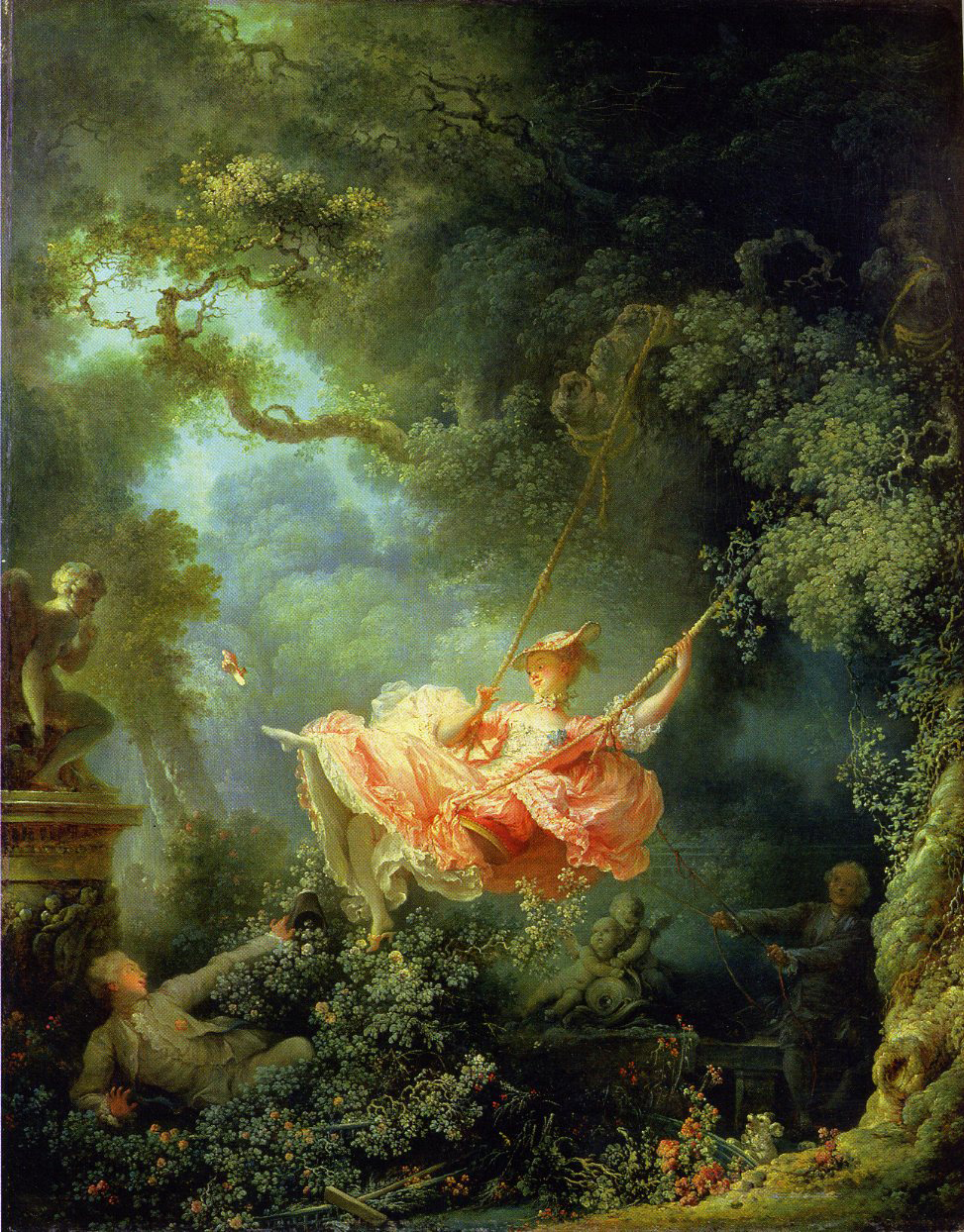
After watching Sophia Copola`s Marie Antoinette, I was curious about the real French Queen, and picked up the biography Marie Antoinette by Antonia Fraser. The movie is a bit fanciful, but is a mere pop version of this important historical personage (apparently the book was Sophia`s primary reference). I did enjoy it, but being a devotee of history, I longed for the actual dame of the Austrian court. I am only on page 51, but I detect that it is well researched, and am enjoying it immensely. "Let Them Eat Cake!" This is a phrase that echoes throughout infamy (prep schools, union halls, or menacing water holes mostly). There is not a shred of evidence that Marie ever said it, if you listen to scholars, but it has come to symbolize the contempt that the aristocracy of France had for the people of the lower estates. Just how over-the-top was the French court in the years leading up to the French Revolution? Was the atmosphere of the latter days of the ancien regime at Versailles as luxurious as it is depicted in books and films? I am hoping this book will perform surgery on some of the thick skins of exaggeration that have here-to-fore been the preponderance of portrayals for the Sun King court. A few years ago I got hooked on Francois Boucher simply because he was so frothy, so decadent-almost more so than one could believe? I visited a Kimball exhibition a couple of years back, and was befuddled by all the angels, cherubim, seraphim etc...How did the art develop such as this, to this silky silliness, with mountains of pinkish flesh in a transparent (or fake) religious theme? This astounded me, and made me want to study the period more to decode these aberrations. Too, the example of Fragonard`s The Swing is given, to slam home the point that mid-18th century France was a plump goose ready to implode with social/political mutiny! This was convincing, when I scribbled down these developments in my history notebooks. "Yea, there it is, the flagrant opulence of the ancien regime, no mercy dude!"
The above portrait by Louise Elizabeth Vigee-Lebrun, while very staged, gives you a good idea of what Marie was like; sumptuous, haughty, majestic, stoic, or maybe just downright in fruitcake city? Was this the real Marie, or just a facade for the public? I will probe for that as I read the book. Louise Vigee-Lebrun did many other portraits of the Queen, so they provide visual fodder for the mozaic of a gazillion words in Antonia Fraser`s text. There is a documentary on Madame Antoine too; I ordered it on Netflix, but it malfunctioned when I was playing it, so I intend to actually purchase it, because it is well done. Maybe some day I can go to France, so that I can visit the haunts of the aforementioned lady, then I will really sense the way it went down! "Let Them Eat Cake", in the meantime (you may want to view this slideshow as you contemplate this fallacious trigger for the Fall of the Bastille)!
Sunday, May 20, 2007
Fay Grim, Waitress, & 28 weeks Later
The Dobie Theater was a little too hot yesterday, but it got colder as the movie progressed. Fay Grim really got bogged down in silly, spy-chit chat that didn`t make any more sense than a fly that was flittin` `bout my nose! Read Roger Ebert`s piece, and boy am I glad he`s back. Parker Posey grimaces, snarls, winks, etc...and is reckless fashion-plate for this lunkey flick. But she can`t save it...this is Ian Fleming gone south. I know I need to see Henry Fool, but I`m reluctant to do so after this clunker! Loved the high-definition though and good shots of Istanbul.
Waitress was a very cute little film that recalls an easier, more innocent age, which would not be our own however. There was something untrue about it, and i don`t know just why? The pie-recipes in it were interesting. Andy Griffith is good as the bitter, wealthy owner. Keri Russel is good and Adrienne Shelly plays a dumb, nerdy flap-jacker strutter who hitches to a bad-poetry dork. It is tragic about her murder late last year.
My favorite of these three was 28 Weeks Later, especially because of the birds-eye shots of London, and the senseless slaugher by the government to annilhilate the carriers of the Rage virus. Because of the virus, people lose feeling for one another. Whenever a carrier tries to eat someone, they move real fast and snatch up their lunch before you can whistle dixie! Dark comedy really-modern George Romero. There is a real rockin` soundtrack-kind of sounded like King Crimson, but I`ll have to check it out! Just about everyone gets slaughtered, and you already knew that, but it`s still a big bummer. Wasn`t great, but it was the best of these three that i`ve seen the last two weeks. I want to see Away From Her today, but I`m not gettin` strongly behind it...
Waitress was a very cute little film that recalls an easier, more innocent age, which would not be our own however. There was something untrue about it, and i don`t know just why? The pie-recipes in it were interesting. Andy Griffith is good as the bitter, wealthy owner. Keri Russel is good and Adrienne Shelly plays a dumb, nerdy flap-jacker strutter who hitches to a bad-poetry dork. It is tragic about her murder late last year.
My favorite of these three was 28 Weeks Later, especially because of the birds-eye shots of London, and the senseless slaugher by the government to annilhilate the carriers of the Rage virus. Because of the virus, people lose feeling for one another. Whenever a carrier tries to eat someone, they move real fast and snatch up their lunch before you can whistle dixie! Dark comedy really-modern George Romero. There is a real rockin` soundtrack-kind of sounded like King Crimson, but I`ll have to check it out! Just about everyone gets slaughtered, and you already knew that, but it`s still a big bummer. Wasn`t great, but it was the best of these three that i`ve seen the last two weeks. I want to see Away From Her today, but I`m not gettin` strongly behind it...
Friday, May 11, 2007
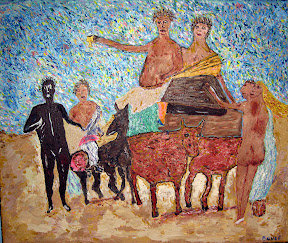
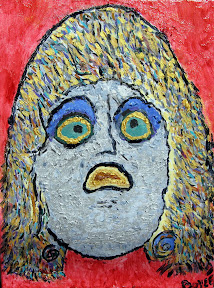
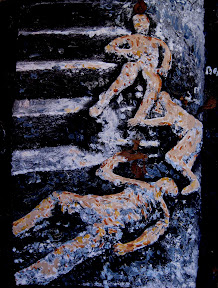
NEW ART FROM CLAUDE BOVEE!
The Triumph of Bacchus XI
Comic Mask

Tragic Mask
Victims of Vesuvius
Venus of the Fountain
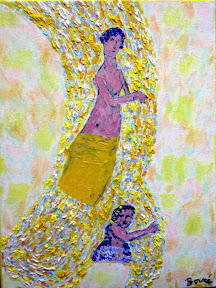
Pyramus & Thisbe
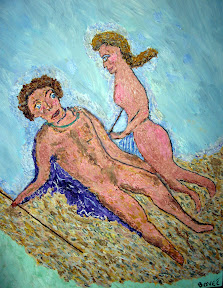
The Sacrifice of Iphigenia
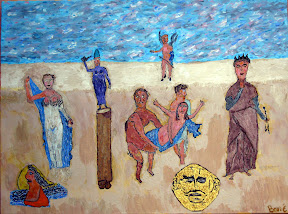
Comic Mask
Tragic Mask
Victims of Vesuvius
Venus of the Fountain
Pyramus & Thisbe
The Sacrifice of Iphigenia
Subscribe to:
Comments (Atom)